











How Long Does Emface Last? A Clear Look at Your Results Timeline
If you're considering Emface for a firmer, more lifted look without a scalpel or a recovery period, the first thing you probably want to know is: how long does Emface actually last?
Most patients hold their results for six months or longer after a completed series of four to six sessions, with the fullest effect showing up around 90 days after the final treatment, and periodic maintenance sessions keeping it there.
Because Emface pairs synchronized radiofrequency with facial muscle stimulation, it works on your skin and the muscles underneath it at the same time, so the changes build steadily over weeks rather than appearing overnight, and they ease off gradually instead of stopping on a fixed date. In this guide, we'll walk you through the complete results timeline stage by stage, explain exactly what shapes your personal response, show you what the peer-reviewed research actually measured, compare Emface to the treatments people weigh it against, and tell you what to expect when you visit us. So let's dive deeper into the details
Key takeaways
- A standard course runs four to six sessions, spaced about one week apart.
- A single appointment runs about 20 minutes, and you can head straight back to work, the gym, or errands.
- Results peak near the 90-day mark, not on the day of your last visit.
- For most people, the improvement sticks around for half a year, and frequently well past that.
- Published clinical trials measure outcomes for up to three months. Longevity beyond that comes from clinical experience and depends heavily on maintenance.
Thinking about Emface for a firmer, lifted look without a scalpel or a recovery period? The question almost everyone asks before booking is the one in the title, and it deserves a straight answer rather than a marketing number.
Because Emface pairs synchronized radiofrequency with facial muscle stimulation, it works on your skin and the muscles underneath it at the same time. The changes build steadily over weeks rather than appearing overnight, and they ease off gradually instead of stopping on a fixed date. Below you will find the results timeline broken down stage by stage, what the peer-reviewed research actually measured, the variables that decide how your own skin responds, how Emface compares to the treatments people weigh it against, and what an appointment at ThinWorks involves.
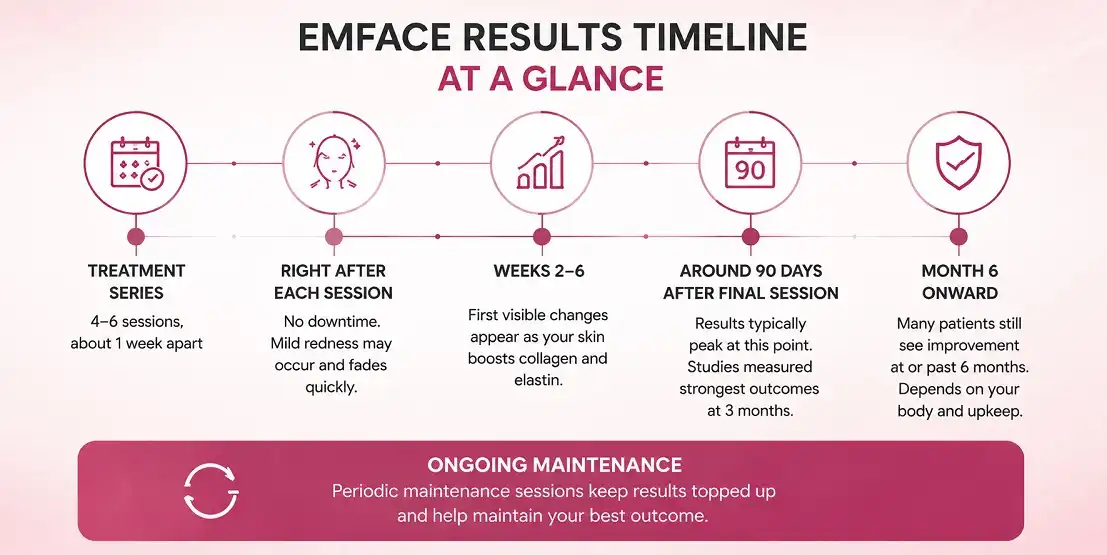
Emface Results Timeline at a Glance
How Long Do Emface Results Last?
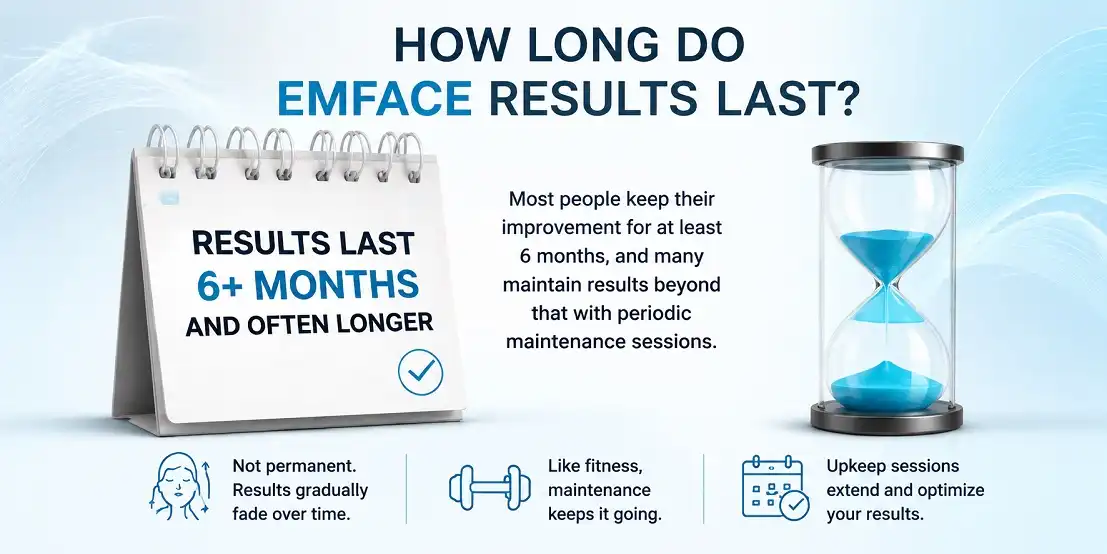
Most people keep their Emface improvement for at least half a year, and plenty hold it past that mark. Two people who finish the same series can land in different places within that range, and that is normal.
At ThinWorks, we would rather give you a realistic window than a number that sounds impressive and then disappoints you later. The honest framing is this: Emface is not permanent, and no one should tell you otherwise. It is a treatment you maintain, much the way you maintain fitness gains. Your facial muscles respond to stimulation, and collagen production naturally slows over time, so periodic sessions are what keep the effect going.
You will see longer figures quoted elsewhere, including claims of a full year. The source behind those figures is worth a closer look. The published trials on this technology followed patients for three months, and the authors of the largest lifting study state plainly that durability at six and twelve months has not yet been established in a controlled setting. Six months or longer is the window we can consistently stand behind. Anything past that is a reasonable expectation for a well-maintained patient, not a proven trial result.
How Long Does One Emface Session Take?
A single Emface appointment is short: roughly 20 minutes from setup to finish. You lie back while the applicators are positioned on the treatment area, and there is nothing to recover from afterward.
A full course of four to six sessions spaced one week apart runs four to six weeks from your first appointment to your last. Factoring in the 90-day window for results to peak, plan on roughly four to five months from starting treatment to seeing your final outcome.
How Does Emface Work, and Why Do Results Build Over Weeks?
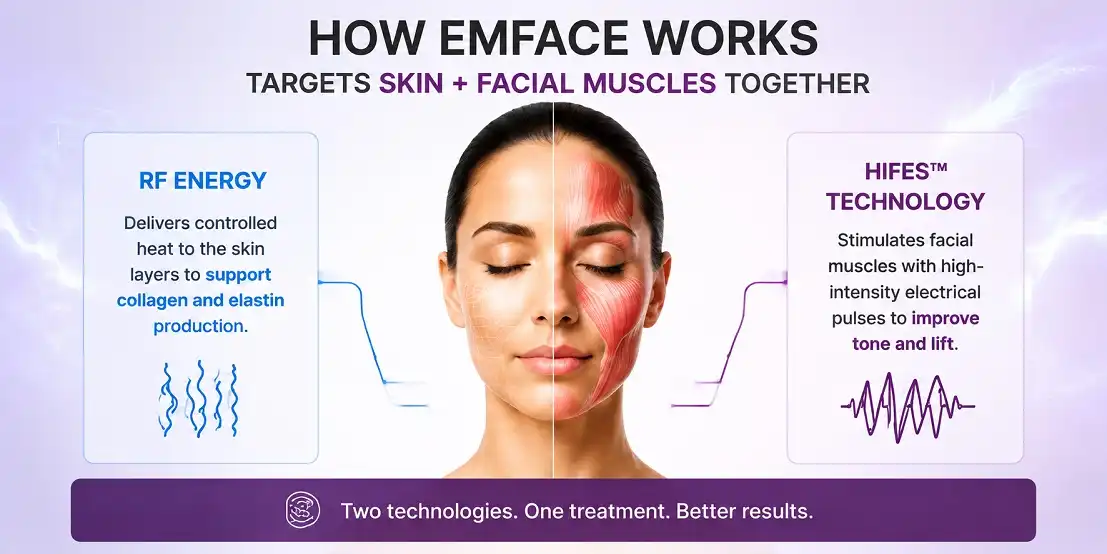
Emface is a needle-free facial treatment that targets two structures in a single pass: the skin itself and the muscle sitting underneath it. Two energies run at once. Radiofrequency (RF) warming is paired with HIFES, a high-intensity electrical stimulation aimed specifically at the facial muscles.
The RF side warms the dermis in a measured, controlled way, which prompts the skin to build fresh collagen and elastin. The HIFES portion stimulates the facial muscles to improve muscle tone. That combination is the reason the timeline works the way it does.
Skin changes and muscle changes both build over weeks, not minutes. You are not filling a line or freezing a muscle, so there is no instant before-and-after moment. That is also why the results do not vanish on a fixed expiration date. They ease off gradually as your body continues its normal aging process.
If you want to see what that gradual build looks like, our Emface before and after results guide walks through the changes patients notice. Those images are supplied courtesy of treatment providers rather than being photographed at our clinic, and the guide says so.
What Does the Research Actually Show?
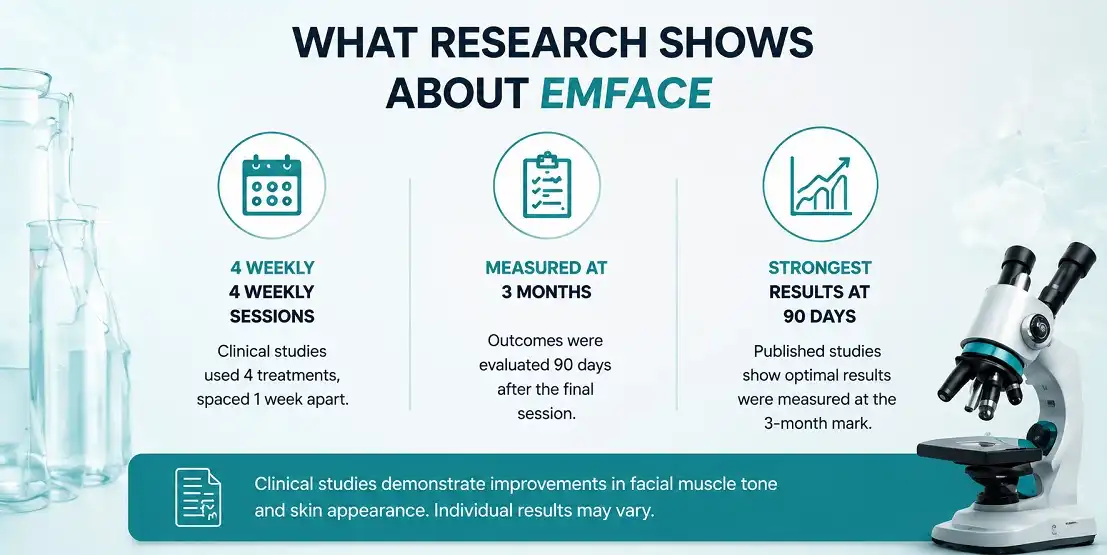
Most pages on this topic quote percentages without saying where they came from. Here is what the peer-reviewed literature reports, with the timepoints attached, because the timepoints are the whole story when you are asking how long something lasts.
Facial lifting and volume. A 2024 study in the Journal of Cosmetic Dermatology treated 21 patients with four weekly 20-minute sessions on the forehead and cheeks. At one month, the average eyebrow lift measured 16.5% (+2.58 mm). At three months, that had risen to 22.2% (+3.25 mm), with an average cheek lift of +3.83 mm and a measurable volume shift from the lower face to the midface. All patients showed overall improvement at three months, and satisfaction was reported at 98.2%. The authors note directly that durability at six and twelve months remains unknown.
Muscle tone. A 2025 pilot study in the Aesthetic Surgery Journal Open Forum used ultrasound echo intensity to measure facial muscle quality after four sessions. It found a statistically significant improvement at three months (P < .005), with 87.5% of patients rated improved on the Global Aesthetic Improvement Scale and 87.5% reporting satisfaction. No adverse events occurred.
Comfort. Both studies measured discomfort rather than assuming it away. Average pain scores landed at 1.4 and 2.9 on a 10-point visual analog scale, which is the clinical equivalent of "mild." That matches how patients commonly describe it: warmth and a light tapping sensation, not pain.
Two things follow from this. First, the three-month peak is not marketing language; it is where the measurements were strongest. Second, anyone quoting a guaranteed twelve-month result is going beyond what has been published.
When Will You Start to See Results?
Early shifts usually surface somewhere between the second and sixth week, commonly once you have two or three visits behind you. The full effect takes longer.
In the weeks after your final visit, the change keeps compounding as collagen and elastin levels continue climbing. Results typically peak around 90 days after your final treatment. The timing is the part most people do not expect, so it helps to plan around it. If you have an event in mind, count backward and give yourself roughly three months of runway after your last session, plus the four to six weeks the series itself takes.
How Often Do You Need Emface Maintenance?
Emface is maintained with periodic follow-up sessions after your initial series. There is no single interval that fits everyone, and ThinWorks sets your schedule around how your own results hold rather than a fixed calendar.
Of everything on this list, this is the one you have real control over, and when you do it, it counts for more than how often. If you book while your results are still holding, one session generally gets you back on track. If you wait until the change has visibly worn off, you are rebuilding from a lower starting point rather than simply holding your ground.
Your maintenance plan is one of the things covered at your consultation.
What Affects How Long Your Results Last?
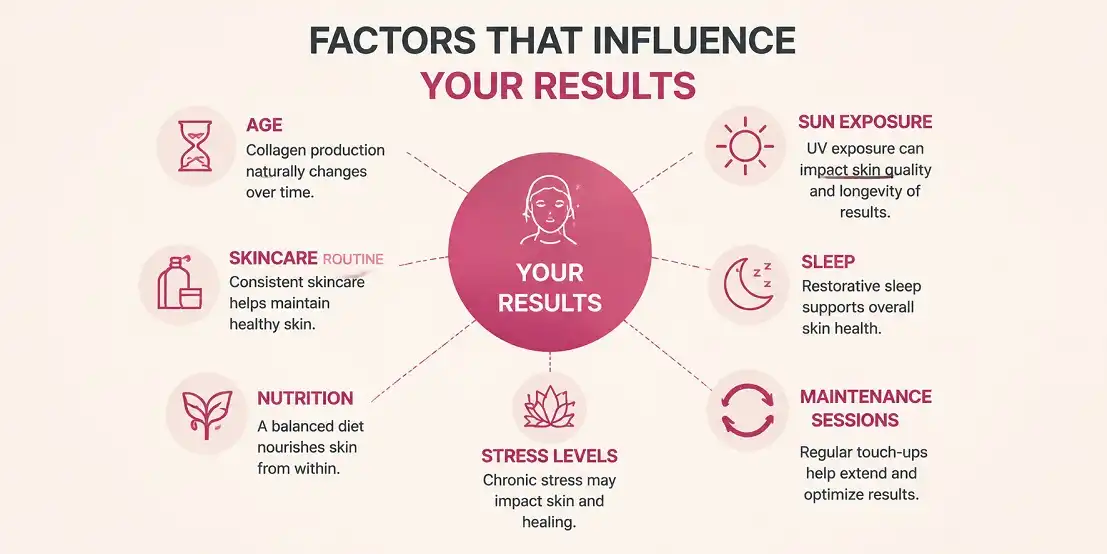
Your timeline is personal. A short list of factors explains why two people can walk away with very different outcomes.
How to Make Your Emface Results Last Longer
You have real influence here. These habits are simple, and they compound.
- Finish the full series your provider recommends. Four to six sessions, one week apart, is the standard structure. Skipping sessions shortens your runway.
- Book maintenance before you need it. Ask your provider what interval suits your results. Scheduled touch-ups keep the effect topped up instead of forcing you to rebuild.
- Apply SPF daily, cloudy mornings and desk-bound days included, not just beach afternoons. UV exposure is the fastest way to undo what you paid for.
- Build a skincare routine you can realistically repeat. Products that support hydration and collagen health give your results a better environment to sit in.
- Sleep well, drink water, and eat properly. These are not throwaway tips. They show up on your face.
- Follow your provider's aftercare guidance. Your plan is shaped around the skin you are working with today, the outcome you want, and how much time you can realistically commit.
How Emface Compares to Other Treatments
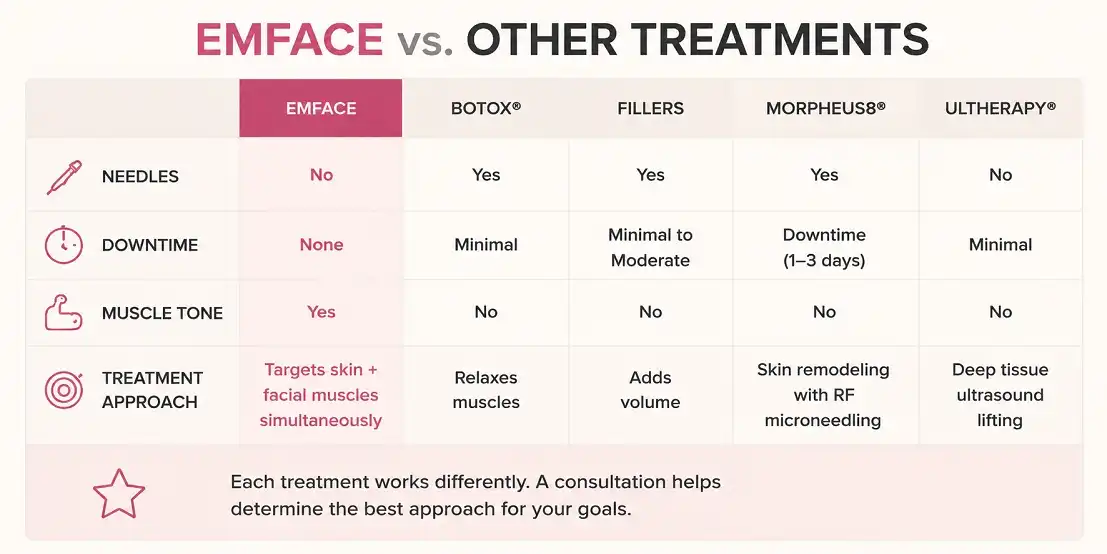
Longevity only means something in context. Here is how Emface sits next to the four options patients ask about most.
Of the treatments in this table, ThinWorks offers Emface and Botox. Dermal fillers, Morpheus8, and Ultherapy are included for comparison only.
Emface and Botox are not competitors so much as different tools. Botox softens lines by putting specific muscles on hold for a stretch of time. Emface takes the opposite route and builds facial muscle tone while improving skin quality alongside it. The two can be used together for a more complete result, though typically not on the same day.
Who Is a Good Candidate for Emface?
Emface tends to suit people who want visible facial rejuvenation but have no appetite for surgery, needles, or time away from their normal routine. It performs well across a wide span of skin tones, textures, and age brackets. The published studies included Fitzpatrick skin types I through V and patients from their mid-twenties to their early sixties.
It works best for people who prefer gradual, natural-looking change over dramatic transformation, and who are comfortable committing to a short series rather than a single visit
A consultation is where your current baseline, the change you are after, and the upkeep that fits your schedule are all discussed. That third point carries more weight than most people assume. Someone who can realistically come back for periodic maintenance will get a different plan than someone who wants one series and no follow-up, and both plans are valid as long as the expectations match.
Who Should Avoid Emface?
Emface suits most faces, but a few health situations rule it out. Bring any of the situations below to your provider's attention before you schedule:
- You wear an implanted electronic device, a pacemaker, a defibrillator, or a medication pump.
- There is a metal or another implant sitting in or close to the area being treated. / You are currently pregnant or breastfeeding.
- You are pregnant or nursing.
- The skin over the treatment area is broken, inflamed, or fighting an infection.
- You have had recent facial surgery or a recent injectable treatment in the area.
- You have a fever, a malignant tumor, or impaired temperature sensation in the face.
This list is not exhaustive. Your provider can review your medical history at the consultation and advise whether Emface is a safe fit for you.
Cost, Sessions, and Planning Ahead
Cost depends on the number of treatments, the areas targeted, and your treatment plan. Our full breakdown of how much Emface costs covers what typically goes into a package, so you can budget with realistic numbers. If you are still deciding how many sessions you need, our guide to how many Emface treatments are needed goes deeper.
When you plan, think in terms of a series plus maintenance rather than a one-time purchase. Budget for the initial four to six sessions, then for periodic maintenance visits afterward. That framing makes the value much easier to judge.
The Bottom Line
Emface is not a one-and-done treatment, and it is not permanent either. It sits comfortably in between. You commit to a short series, you give it about 90 days for the full picture, and you get results that typically hold for six months or longer with the right care behind them.
How long your Emface results last comes down to two things you control: finishing the full series, and booking maintenance before your results start slipping. Everything else, from sunscreen and sleep to a steady skincare routine, protects the work you have already paid for.
We offer Emface treatment in Palm Beach Gardens, Florida, and every plan starts with a consultation so we can build the schedule around your goals and your calendar. If you are still deciding whether it is right for you, that consultation is the fastest way to get a realistic answer for your face instead of an average.
Call 561-235-0100 or email pbg@thinworks.com, and our team will give you straight answers matched to your situation.
Frequently Asked Questions
Are Emface Results Permanent?
No. Emface is not permanent. Plan on roughly six months or more from a completed series, and book periodic maintenance sessions to extend it. Where you fall inside that window comes down to your physiology and how well you maintain the result.
How Long Does An Emface Session Take?
Around 20 minutes, start to finish. A full course of four to six sessions spaced one week apart takes four to six weeks from start to finish.
How Many Emface Sessions Do You Need?
The standard course runs four to six visits, generally scheduled a week apart. Depending on what you want to change and the current state of your skin, your provider may adjust that count.
How Often Do You Need Emface Maintenance?
There is no fixed schedule. Emface is maintained with periodic follow-up sessions after your initial series, and your provider sets the timing around how your own results hold. Book while your results are still holding rather than after they have faded.
How Long Does Emface Take To Work?
Most patients notice early changes within two to six weeks of starting, often after the second or third session. Results peak around 90 days after the final treatment.
Does Emface hurt?
No. Most patients describe it as comfortable, comparing the sensation to a gentle facial massage with noticeable warmth and a light tapping as the muscles contract.
Is There Downtime?
There is no downtime. You can walk out and carry on with the rest of your day as planned. Mild flushing right after a session is normal and typically settles quickly.
Who Should Not Get Emface?
Emface is generally not suitable if you have an electronic implant such as a pacemaker or defibrillator, metal implants near the treatment area, an active skin infection in the area, or if you are pregnant. At your consultation, expect a full run-through of your medical background.
Can Emface Be Combined With Other Treatments?
Yes. Emface works well alongside other aesthetic procedures ThinWorks offers, including Botox, Exion, and exosome therapy for a fuller, more noticeable result. The usual requirement is that they are scheduled on separate days rather than stacked into one visit.
Is Emface Worth It?
For most patients who want gradual improvement without needles, surgery, or recovery time, and who are willing to maintain it, yes. If you are hoping for a single treatment with permanent results, Emface is not that, and a consultation will give you a straight answer for your situation.
Related Blogs

Dr. John Bacha, specializing in bariatric surgery, offers expert guidance and personal insights to help patients achieve their weight loss goals. Visit to know more.
View Profile


%401x.svg)
