











How Long Does It Take for B12 Injections to Work? A Realistic Timeline
If you're considering your first B12 shot, the question on your mind probably is How Long Does It Take for B12 Injections to Work? It depends on factors such as your starting B12 levels, the reason your levels are low, and how your body responds to treatment.
Most people begin noticing changes within a few days to weeks, while improvements in blood values and nerve-related symptoms can take longer. Because B12 injections deliver the vitamin directly into your muscle and bloodstream, they bypass the digestive process that oral supplements rely on, allowing your body to access B12 more efficiently.
In this guide, we'll break down the complete B12 injection timeline from the first few hours through the following months, explain what can influence your personal response, compare injections with oral B12 options, and walk you through what to expect during an appointment with us. So let's dive deeper into the details.
B12 Injection Results Timeline at a Glance
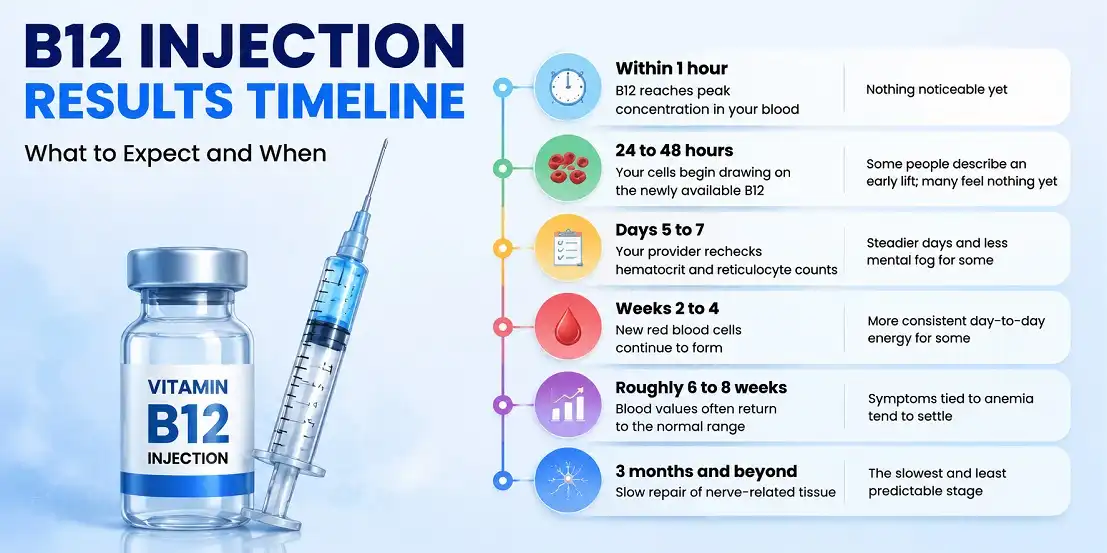
Timing is individual. Two patients whose blood work looks nearly identical can land on completely different schedules.
Why Injections Move Faster Than Pills
Swallowed B12 has to survive stomach acid, bind to a protein called intrinsic factor, and get absorbed in the last section of your small intestine. If any part of that chain isn't working, most of the dose never reaches your bloodstream.
An intramuscular injection skips that chain entirely. The dose enters muscle tissue and moves directly into circulation, which is why blood levels peak so quickly. The NIH Office of Dietary Supplements notes that injections are typically used when absorption is the problem, such as pernicious anemia, for example, or other conditions that keep the gut from taking B12 in, because this route "bypasses any barriers to absorption."
Injections vs. Oral B12: An Honest Comparison
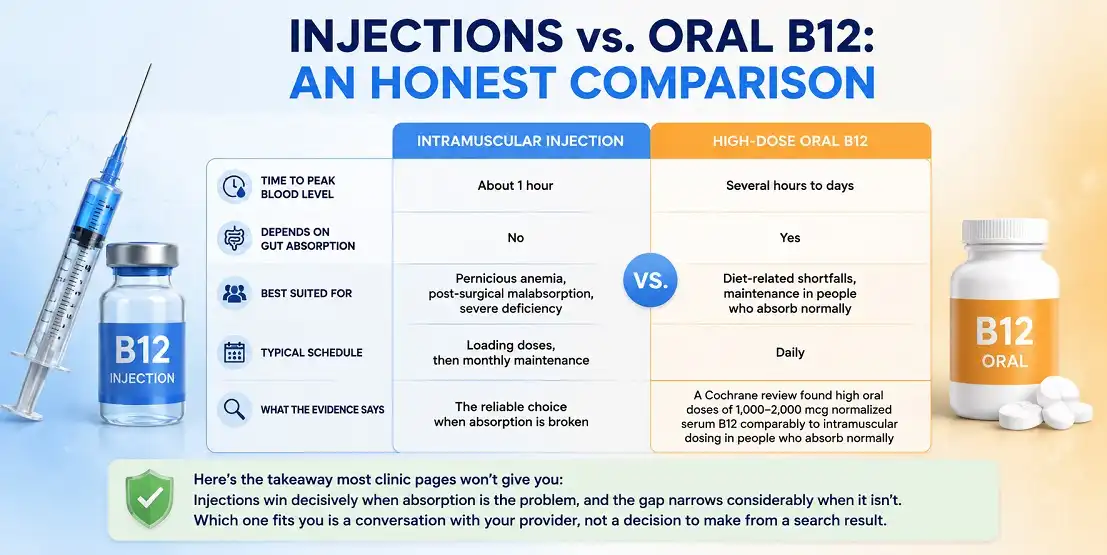
Here's the takeaway most clinic pages won't give you: injections win decisively when absorption is the problem, and the gap narrows considerably when it isn't. Which one fits you is a conversation with your provider, not a decision to make from a search result.
If you're comparing formats, our guide on how long a B12 shot lasts covers the duration side of the question, and our post on B12 shots vs. pills weighs the two formats side by side.
The First 24 to 48 Hours
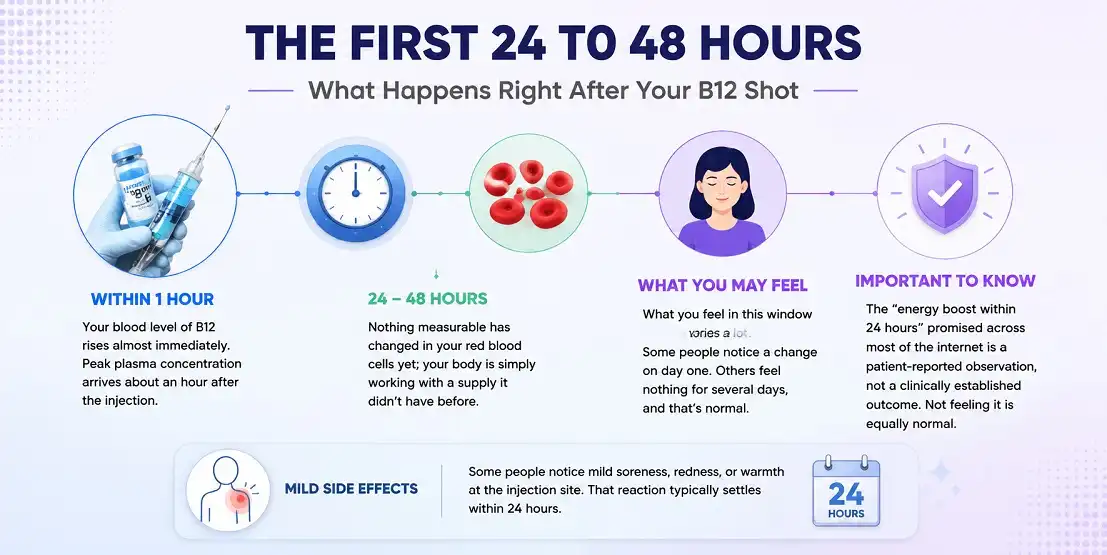
Your blood level of B12 rises almost immediately. Peak plasma concentration arrives about an hour after the injection.
What you feel in this window varies a lot. Some people describe a change on day one. Others feel nothing for several days, and that's a normal response, not a sign the shot failed. Nothing measurable has changed in your red blood cells yet; your body is simply working with a supply it didn't have before.
The "energy boost within 24 hours" promised across most of the internet is a patient-reported observation, not a clinically established outcome. Feeling it is common. Not feeling it is equally normal, and it isn't a reason to abandon the schedule after one shot.
Some people notice mild soreness, redness, or warmth at the injection site. That reaction typically settles within 24 hours.
Days 5 Through 7: The First Changes You Can Point To
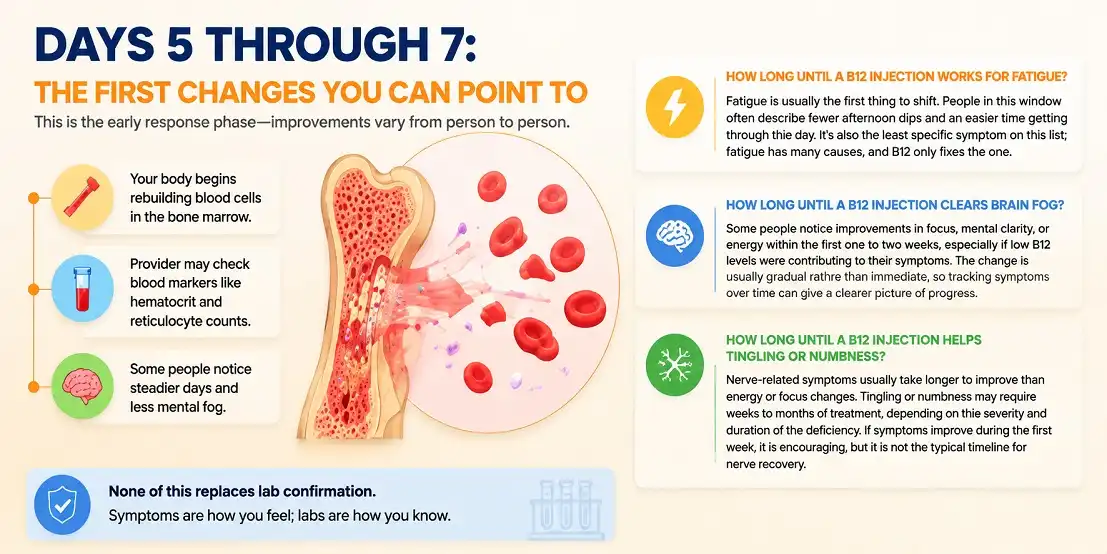
This is the period when your provider can begin checking whether your body is responding to treatment. The FDA prescribing information for cyanocobalamin injection notes that hematocrit and reticulocyte counts may be monitored daily during days five through seven of therapy.
Reticulocytes are young red blood cells that haven't fully matured yet, and a rise in their number is one of the first lab changes showing your marrow has kicked into gear. If your provider ordered baseline blood work before your injection, this is often when follow-up labs may be reviewed to track your progress.
How Long Until a B12 Injection Works for Fatigue?
Fatigue is usually the first thing to shift. People in this window often describe fewer afternoon dips and an easier time getting through the day. It's also the least specific symptom on this list; fatigue has many causes, and B12 only fixes the one.
How Long Until a B12 Injection Clears Brain Fog?
Some people notice improvements in focus, mental clarity, or energy within the first one to two weeks, especially if low B12 levels were contributing to their symptoms. The change is usually gradual rather than immediate, so tracking symptoms over time can give a clearer picture of progress.
How Long Until a B12 Injection Helps Tingling or Numbness?
Nerve-related symptoms usually take longer to improve than energy or focus changes. Tingling or numbness may require weeks to months of treatment, depending on the severity and duration of the deficiency. If symptoms improve during the first week, it is encouraging, but it is not the typical timeline for nerve recovery.
None of this replaces lab confirmation. Symptoms are how you feel; labs are how you know.
Weeks 2 to 4: Building Back
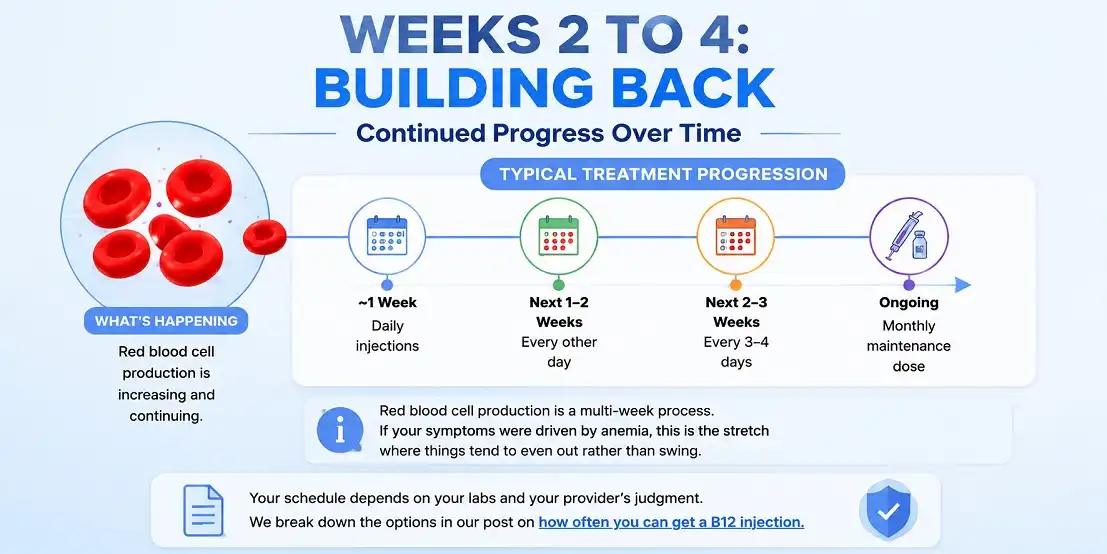
Red blood cell production is a multi-week process. If your symptoms were driven by anemia, this is the stretch where things tend to even out rather than swing.
Standard treatment schedules reflect that. A common protocol starts with daily injections for about a week, moves to alternate days, then to every three or four days, and finally to a monthly maintenance dose. Your own schedule depends on your labs and your provider's judgment. We break down the options in our post on how often you can get a B12 injection.
Roughly 6 to 8 Weeks: Blood Values Normalize
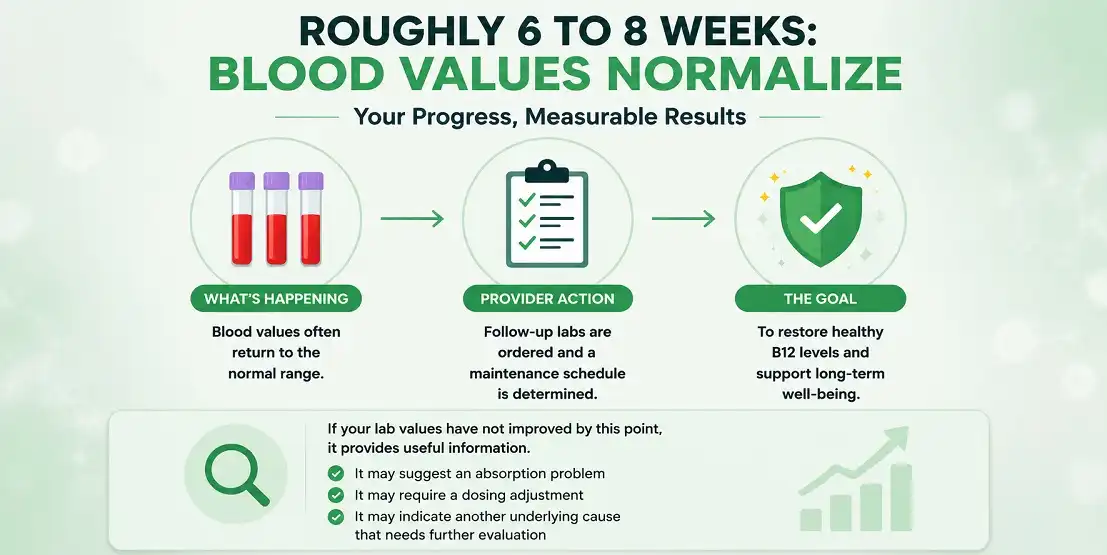
By the end of the initial treatment period, blood values have often returned to the normal range for many people with B12 deficiency. This is typically when your provider may order follow-up labs and determine a maintenance schedule.
If your lab values have not improved by this point, it provides useful information. It may suggest an absorption problem, dosing adjustment, or another underlying cause that needs further evaluation.
3 Months and Beyond: The Slow Stage
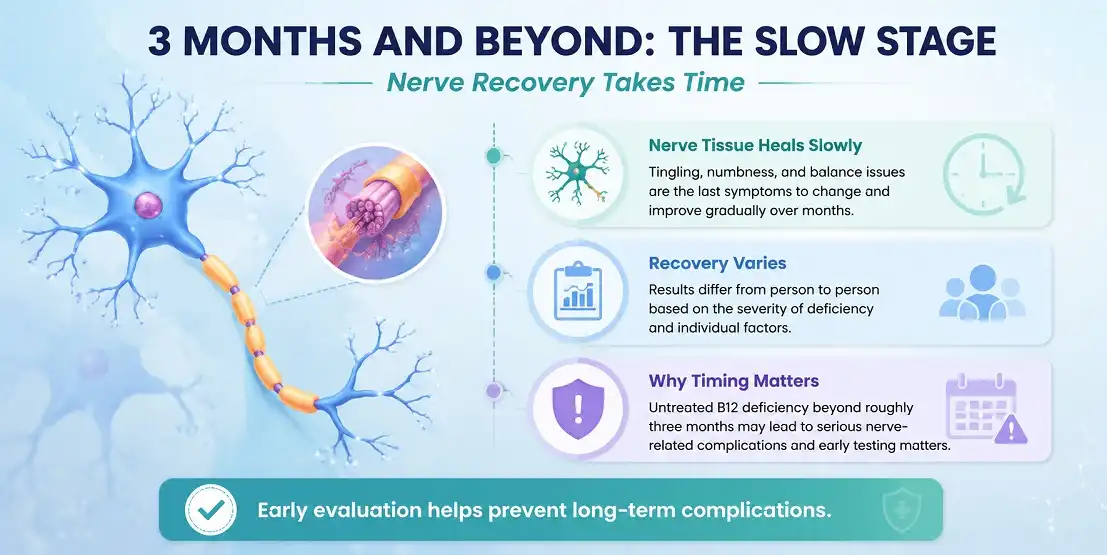
Nerve tissue repairs slowly. Symptoms like tingling in the hands and feet, numbness, or balance problems are the last to change, and they change gradually over months rather than weeks.
There's also a time factor worth knowing. FDA prescribing information warns that a B12 deficiency left unaddressed beyond roughly three months can produce permanent degenerative changes in the spinal cord. That's why providers push for early testing rather than watchful waiting, and why "I'll see how I feel in a few months" is the one approach we'd steer you away from.
Does the Type of B12 Change the Timeline?
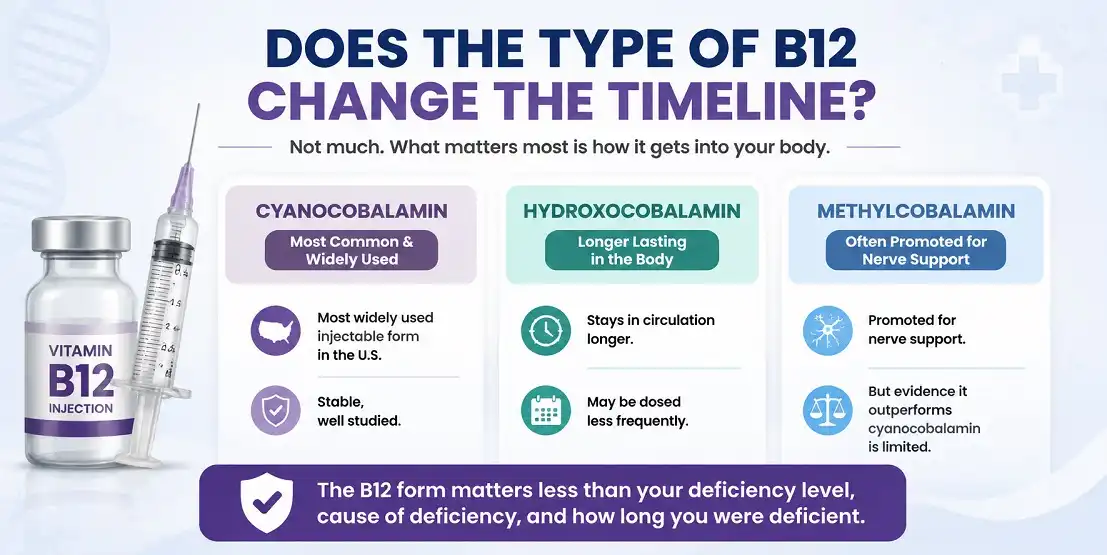
Three forms show up in clinical use, and the differences are smaller than the marketing suggests:
- Cyanocobalamin is the most widely used injectable form in the United States and the one the FDA labeling above describes. It's stable, inexpensive, and well studied.
- Hydroxocobalamin stays in circulation longer, so it's sometimes dosed less frequently. It's the standard injectable form in the United Kingdom.
- Methylcobalamin, a ready-to-use form of the vitamin, gets promoted aggressively for nerve support. Evidence that it outperforms cyanocobalamin for correcting a deficiency is limited.
For the question at hand, how fast you feel and measure a response, the form you receive matters far less than how deficient you were, why you were deficient, and how long you were deficient.
What Changes Your Personal Timeline
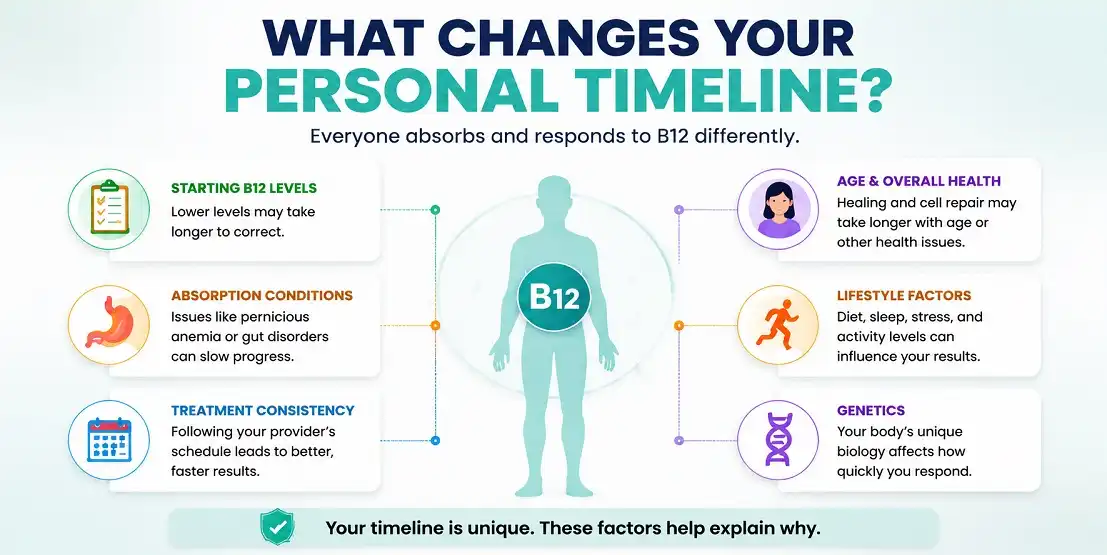
Several things move the needle in either direction:
- How low you started. Someone with a borderline level and someone with a severe deficiency won't follow the same curve.
- Why were you low? Diet-related shortfalls behave differently from absorption problems like pernicious anemia or post-surgical malabsorption.
- How long were you low? A longer deficiency generally means a longer recovery, particularly for nerve-related symptoms.
- Your dosing schedule. A loading sequence works differently from a single shot.
- Everything else that's going on. Thyroid issues, iron or folate status, sleep, and medications all shape how you feel, and B12 fixes none of them.
That last point matters. If your fatigue was never caused by low B12, a B12 injection isn't the variable that will change it.
How to Tell Whether It's Actually Working
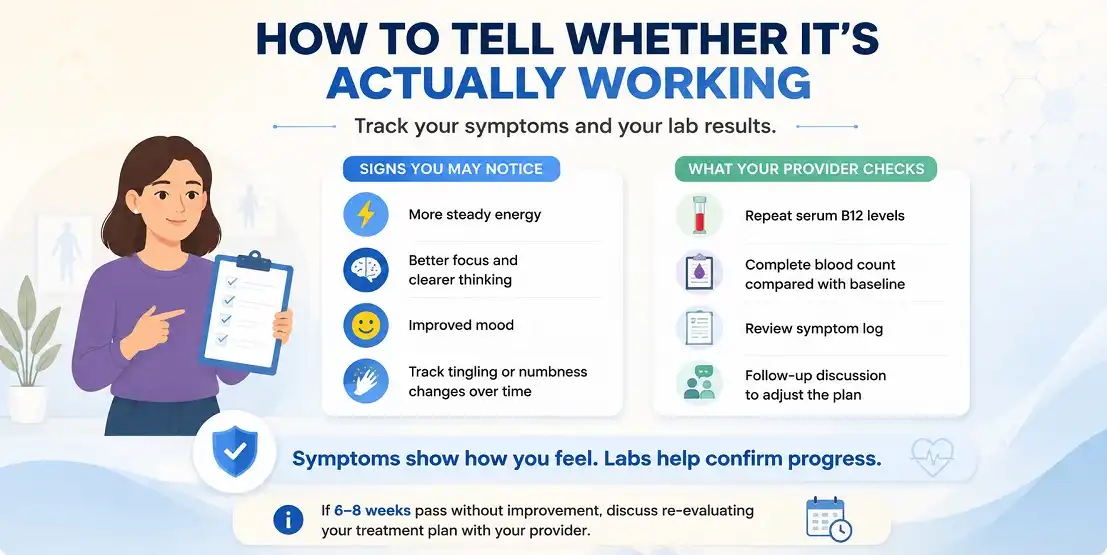
Three things are worth tracking:
- Repeat labs. Your provider compares serum B12 and, often, a complete blood count against your baseline.
- A simple symptom log. Note energy, focus, and any tingling weekly rather than hourly. Day-to-day noise hides real trends.
- A follow-up conversation. Bring the log and the labs to your provider so the schedule can be adjusted with evidence rather than guesswork.
If six to eight weeks pass with no change in your labs or your symptoms, tell your provider. Read that as a cue to re-evaluate the plan rather than to stack on extra injections.
What to Expect During the Appointment
The injection takes a couple of minutes and goes into the muscle, usually the shoulder, upper arm, or thigh.
Reported side effects are generally mild and short-lived: soreness or swelling at the site, mild nausea, headache, or a brief flushed feeling. Allergic reactions are rare. Tell your provider beforehand about any cobalt or cobalamin allergy, any kidney condition, and every medication and supplement you take, including folic acid.
How B12 Injections Work at ThinWorks
Every B12 shot here is provided through our ThinWorks clinic in Palm Beach Gardens. Learn more about our Vitamin B12 injections in Palm Beach Gardens, Florida. If you already know B12 is what you need, a B12 shot is just one appointment away. If you're not sure whether fatigue is the symptom and the cause is still an open question, start with a consultation instead, so our medical team can review your needs before recommending a treatment plan.
That distinction is important when considering B12 injections. Our team provides MIC-B12 and Ultra MIC-B12 injection options as part of our wellness services, with guidance from our medical professionals to help determine the right approach for your goals.
The Bottom Line
B12 shots run on two clocks at once. The first is quick: your level peaks within an hour, and by days 5 to 7, your provider can usually measure a response in your blood work. The second is slower and far more personal, stretching from a few weeks for blood counts to several months for nerve-related symptoms.
So give it time, but give it structure. Get your baseline labs, keep a simple weekly log, stick to the schedule your provider sets, and recheck at six to eight weeks. If you still notice no change by that point, book a follow-up discussion with your clinician instead of scheduling one more shot. Knowing what to expect at each stage is what keeps a perfectly normal timeline from feeling like a failed one.
Still wondering how your own B12 timeline will play out? Email pbg@thinworks.com or call 561-235-0100, and our team will give you straight, personalized answers. You can also read our related guides on B12 injection benefits and B12 injection sites.
Frequently Asked Questions
How Long Does It Take For B12 Injections To Work If I'm Severely Deficient?
Blood levels still peak within about an hour, but symptom change takes longer. Providers typically look for a reticulocyte response by days 5 to 7 and normalized blood values by roughly 6 to 8 weeks. Nerve symptoms from a severe, long-standing deficiency can take six months or more to improve.
How Soon Will I Feel Less Tired After A B12 Injection?
Some people report a difference within 24 to 72 hours; others need several weeks. Fatigue relief is the earliest commonly reported change, but it's also the least specific. If your fatigue has another cause, B12 won't resolve it. Our full guide covers how soon you feel less tired after a B12 injection.
How Long Does One B12 Shot Last?
About four weeks for most people on maintenance, which is why monthly schedules are standard. The exact duration depends on your dose, your baseline level, and how much B12 your liver has stored.
Can I Feel Worse After A B12 Injection?
Yes, briefly. Tenderness at the injection site, a headache, or slight queasiness during the first 24 to 48 hours happens fairly often and typically clears without treatment. If any of it sticks around beyond two days, phone your clinician.
Do B12 Injections Work Faster Than Tablets?
Yes. Injections reach peak blood levels in about an hour because they bypass digestion entirely, while oral B12 depends on stomach acid and intrinsic factor. How much that speed matters depends on whether your gut absorbs B12 properly; in people who absorb normally, high-dose oral B12 can normalize levels comparably over time.
How Often Should I Get B12 Injections?
Most loading schedules start with daily or every-other-day injections for the first one to three weeks, then taper to a monthly maintenance dose. How far apart your shots fall is something your clinician determines from your bloodwork and why you started treatment in the first place. See our guide on how often you can get a B12 injection.
Should I Get Blood Work Before Starting B12 Injections?
Yes. Baseline serum B12 and a complete blood count give you something to compare against. Skip the starting labs, and you're left guessing. You can't confirm the shots are doing anything or rule out that something else was driving how you felt.
What If B12 Injections Don't Work For Me?
If six to eight weeks pass with no change in your labs or symptoms, that points to something other than a simple deficiency, an absorption problem, an inadequate dose, or a separate underlying condition. What follows should be a repeat blood panel and a sit-down with your clinician, not more injections.
Related Blogs
- How Quickly Does B12 Shot Work
- How Long Does a B12 Shot Last
- Everything You Need to Know About Vitamin B12
Note* The information here is educational in nature and does not replace personalized guidance from your own clinician. Bring your specific symptoms, bloodwork, and treatment questions to a licensed clinician.

Dr. Jaime Snarski is our Medical Director, who combines bariatric expertise with a passion for preventive health & personalized weight management. Visit to know more.
View Profile


%401x.svg)
